A little while back I used my company‘s global learning community of practice to ask its members who their learning gurus were. It was an interesting exercise because it gave me some insight into which people and ideas have influenced the current learning practice in the company. I was expecting names like Stephen Downes, George Siemens or Jay Cross to come up, instead we had an interesting discussion about the word “guru” and people mentioned names like Robert F. Mager (famous for the question: could they do it if their life depended on it?), Betty Collis and Peter Senge.
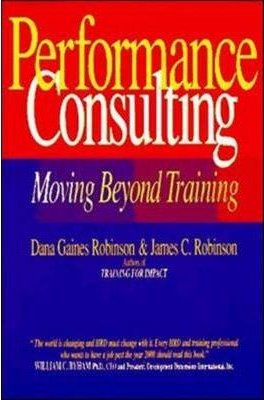
One of the books that was mentioned in the discussion was Performance Consulting: Moving Beyond Training by the Robinson couple. This 1995 book (hello CD-ROMS!) seems to be a bit of a classic in the field. The blurb on the cover says: “The world is changing and HRD must change with it. Every HRD and training professional who wants to have a job past the year 2000 should read this book.” Reading the book it struck me how many of its lessons were still not in regular practice in many businesses today (i.e. the blurb was wrong!).
The book tries to explain how the traditional role of the trainer (focus on what people need to learn) can be progressed to the role of a performance consultant (focusing on what people need to do to perform well). A trainer (and the learning function as a whole) describes and solves training needs. A performance consultant looks at business, performance, training and work environment needs. The idea is to have the learning department be part of the business conversation. By breaking out of the conspiracy of convenience (see barrier 3 in this Charles Jennings post) learning professionals would be able to create a “Performance Relationship Map” to really impact business results:
From page 55 of the book
Using this map you can see that what the operational results should be, drive what the on-the-job performance should be. These can then be compared to how they currently are and internal and external causes (the environmental factors) can be identified. This very simple model is probably in the tool kit of any organizational effectiveness consultant, but is still not something many people in the learning space would explicitly use.
The book then describes how to get the information to fill in this map. What I really liked is how they decided to use the people who excel at their work, the best performers, to find out what performance should be like and define the benchmark to measure the current performance against. This is a simple trick that learning designers could start doing right now: don’t go and find the Subject Matter Experts to ask them what people should know about a particular topic, instead ask people who are great performers what it is they actually do and ask their managers why they are such great performers. That is a much better starting point for designing a learning intervention.
The majority of the book is devoted to building the performance relationship map. What really surprised me that once you have identified the gaps, the proposed solutions for closing the gap are still so traditional. Even though the authors quote Geary Rummler saying “Pit a good employee against a bad system and the system will win most every time” and even though they come up with the equation Learning Experience x Work Environment = Performance Results, they fall way short in their solutions for closing the performance gap and don’t actually look at changing the system.
They don’t talk about new models for training and learning. How the work environment could be changed receives half a page in the book (find it at the bottom half of page 269). It is a bit odd that you would spend a whole book explaining how to do a needs analysis and then write in chapter 11 (of 13): “If all we did was obtain data, Performance Consultants would be of limited value. The ultimate test of a consulting project is how the information is actually used to make desirable changes.” This means they have left the most interesting questions open. Could I maybe get your recommendation for literature that would give me more information about the next step: how to close a performance gap? I would prefer books that have taken the rise of educational technology and the Internet truly on board.
Bonus: One nice reference that I came across in the book was to The Consultant’s Calling by Geoffrey M. Bellman. The Robinsons quoted the following passage (in the context of defining what a contract might mean):
I attempt to create a contracting process with my clients that is alive and adaptable, not one that is fixed in ink. I encourage trust between client and consultant. I see anything that smacks of mistrust – as defensive legal contracts can do – as damaging to the partnership I want to establish. I favor written communication that records what we decided so we don’t forget our responsibilities. I keep files tracking the work the client and I are doing together, but I balk at anything written that suggest we need to protect ourselves from each other.
Lovely.
BTW, this was post number 100 on this blog! I seem to have finally found some persistence…
I have been involved in organizing a workshop on capability building in organizations hosted on my employer‘s premises (to be held on October 20th). We have tried to get together an interesting group of professionals who will think about the future state of capability building and how to get there. All participants have done a little bit of pre-work by using a single page to answer the following question:
What/who inspires you in your vision/ideas for the future state of capability building in organizations?
Unfortunately I cannot publish the one-pagers (I haven’t asked their permission yet), but I have disaggregated all their input into a list of Delicious links, a YouTube playlist and a GoodReads list (for which your votes are welcome). My input was as follows:
Humanistic design
We don’t understand ourselves well enough. If we did, the world would not be populated with bad design (and everything might look like Disney World). The principles that we use for designing our learning interventions are not derived from a deep understanding of the humand mind and its behavioural tendencies, instead it is often based on simplistic and unscientific methodologies. How can we change this? First, everybody should read Christopher Alexander’s A Pattern Language. Next, we can look at Hans Monderman (accessible through the book Traffic) to understand the influence of our surroundings on our behaviour. Then we have to try and understand ourselves better by reading Medina’s Brain Rules (or check out the excellent site) and books on evolutionary psychology (maybe start with Pinker’s How the Mind Works). Finally we must never underestimate what we are capable of. Mitra’s Hole in the Wall experiment is a great reminder of this fact.
Learning theory
The mental model that 99% of the people in this world have for how people learn is still informed by an implied behaviourist learning theory. I like contrasting this with George Siemens’ connectivism and Papert’s constructionism (I love this definition). These theories are actually put into practice (the proof of the pudding is in the eating): Siemens and Stephen Downes (prime sense-maker and a must-read in the educational technology world) have been running multiple massive online distributed courses with fascinating results, whereas Papert’s thinking has inspired the work on Sugarlabs (a spinoff of the One Laptop per Child project).
Working smarter Jay Cross knows how to adapt his personal business models on the basis of what technology can deliver. I love his concept of the unbook and think the way that the Internet Time Alliance is set up should enable him to have a sustainable portfolio lifestyle (see The Age of Unreason by the visionary Charles Handy). The people in the Internet Time Alliance keep amplifying each other and keep on tightening their thinking on Informal Learning, now mainly through their work on The Working Smarter Fieldbook.
Games for learning
We are starting to use games to change our lives. “Game mechanics” are showing up in Silicon Valley startups and will enter mainstream soon too. World Without Oil made me understand that playing a game can truly be a transformational experience and Metal Gear Solid showed me that you can be more engaged with a game than with any other medium. If you are interested to know more I would start by reading Jesse Schell’s wonderful The Art of Game Design, I would keep following Nintendo to be amazed by their creative take on the world and I would follow the work that Jane McConigal is doing.
The web as a driver of change
Yes, I am believer. I see that the web is fundamentally changing the way that people work and live together. Clay Shirky‘s Here Comes Everybody is the best introduction to this new world that I have found so far. Benkler says that “technology creates feasibility spaces for social practice“. Projects like Wikipedia and Kiva would not be feasible without the current technology. Wired magazine is a great way to keep up with these developments and Kevin Kelly (incidentally one of Wired’s cofounders) is my go-to technology philosopher: Out of Control was an amazingly prescient book and I can’t wait for What Technology Wants to appear in my mailbox.
I would of course be interested in the things that I (we?) have missed. Your thoughts?
Arjen Vrielink and I write a monthly series titled: Parallax. We both agree on a title for the post and on some other arbitrary restrictions to induce our creative process. This time we decided to try and find out whether it is possible to engineer serendipity on the web. The post should start with a short (max. 200 words) reflection on what the Internet has meant for serendipity followed by three serendipitous discoveries including a description of how they were discovered. You can read Arjen’s post with the same title here.
There is an ongoing online argument over whether our increasing use of the Internet for information gathering and consumption has decreased our propensity for having serendipitous discoveries (see for example here, here or here). I have worried about this myself: my news consumption has become very focused on (educational) technology and has therefore become very silo-ed. No magazine has this level of specificity, so when I read a magazine I read more things I wasn’t really looking for than when I read my RSS feeds in Google Reader. This is a bit of red herring. Yes, the web creates incredibly focused channels and if all you are interested in is the history of the second world war, then you can make sure you only encounter information about that war; but at the same time the hyperlinked nature of the web as a network actually turns it into a serendipity machine. Who hasn’t stumbled upon wonderful new concepts, knowledge communities or silly memes while just surfing around? In the end it probably is just a matter of personal attitude: an open mind. In that spirit I would like to try and engineer serendipity (without addressing the obvious paradoxical nature of doing that).
Serendipity algorithm 1: Wikipedia
One way of finding serendipity in the Wikipedia is by looking at the categories of a particular article. Because of the many to many relationship between categories and articles these can often be very surprising (try it!). I have decided to take advantage of the many hyperlinks in Wikipedia and do the following:
In these articles find two links that look interesting and promising to you
In each of these four articles pick a link to a concept that you haven’t heard about yet or don’t understand very well
Read these links and see what you learn
Instructional theory was the first link. From there I went to Bloom’s Taxonomy and to Paulo Freire. Bloom’s Taxonomy took me to DIKW, a great article on the “Knowledge Pyramid” explaining the data-to-information-to-knowledge-to-wisdom transformation. I loved the following Frank Zappa quote:
Information is not knowledge,
Knowledge is not wisdom,
Wisdom is not truth,
Truth is not beauty,
Beauty is not love,
Love is not music,
and Music is the BEST.
Paulo Freire took me to Liberation theology which is is a movement in Christian theology which interprets the teachings of Jesus Christ in terms of a liberation from unjust economic, political or social conditions. This began as a movement in the Roman Catholic church in Latin America in the 1950s-1960s. The paradigmatic expression of liberation theology came from Gutierrez from his book A Theology of Liberation in his which he coined the phrase “preferential option for the poor” meaning that God is revealed to have a preference for those people who are “insignificant”, “unimportant” and “marginalized”.
The second link was Learning theory (education). That led to Discovery learning and Philosophical anthropology. Discovery learning prompted me to read the The Grauer School. This link didn’t really work out. The Discovery learning article had alluded to the “Learn by Discovery” motto with which the school was founded, but the article about the school has no further information. A dead alley on the serendipity trail! Philosophical anthropology brought me to Hylomorphism which is a concept I hadn’t heard of before (or I had forgotten about: I used to study this stuff). It is a philosophical theory developed by Aristotle analyzing substance into matter and form. “Just as a wax object consists of wax with a certain shape, so a living organism consists of a body with the property of life, which is its soul.”
Conclusion: Wikipedia is excellent for serendipitous discovery.
Serendipity algorithm 2: the Accidental News Explorer (ANE)
The Accidental News Explorer
The tagline of this iPhone application is “Look for something, find something else” and its information page has a quote by Lawrence Block: “One aspect of serendipity to bear in mind is that you have to be looking for something in order to find something else.” I have decided to do the following:
Conclusion: An app like this could work, but it needs to be a little bit better in its algorithms and sources for finding related news. One thing I noticed about this particular news explorer is its complete US focus, you always seem to go to cities and then to sports or politics.
Serendipity algorithm 3: Twitter
Wikipedia allows you to make fortunate content discoveries, Twitter should allow the same but then in a social dimension. Let’s try and use Twitter to find interesting people. I have decided to do the following:
Search for a the hashtag “#edtech”
Look at the first three people who have used the hashtag and look at their first three @mentions
Choose which of the nine people/organizations is the most to follow
Follow this person and share/favourite a couple of tweets of this person
@MsBarkerED, Education Major, Michigan State University, Senior, Aspiring Urban Educator, enrolled in the course CEP 416
@jdthomas7, educational tech/math coach, former math, computer teacher. former director of technology at a local private school. specializing in tech/ed integration
@ozge, Teacher/trainer, preschool team leader, coordinator of an EFL DVD project, e-moderator, content & educational coordinator of Minigon reader series, edtech addict!
@ktenkely, Mac Evangelist, Apple Fanatic, Technology Teacher, classroom tech integration specialist, Den Star, instructional coach
@Parentella, Ever ask your child: What happened at school today? If so, join us.
@Chronicle, The leading news source for higher education.
@techcrunch, Breaking Technology News And Opinions From TechCrunch
I decided to follow @ozge who seems to be a very active Twitter user posting mostly links that are relevant to education.
Conclusion: the way I set up this algorithm did not help in getting outside of my standard community of people. I was already following @ShellTerrell for example. I probably should have designed a slightly different experiment, maybe involving lists in some way (and choosing an a-typical list somebody is on). That might have allowed me to really jump communities, which I didn’t do in this case.
There are many other web services that could be used in a similar fashion as the above for serendipitous discovery. Why don’t you try doing it with Delicious, with Facebook, with LinkedIn or with YouTube?
A couple of weeks back I was interviewed by Amir Elion who was a guest editor for an Israeli magazine on Human Resources. The interview has now been published (if you can read Hebrew it is available online for free). The publisher has kindly given me permission to publish the English version of the interview on my blog. It might give people a better idea of what I do every day.
Please tell us about yourself, what you do, and how you got there?
Basically I studied to be a philosopher and a physical education teacher. I taught high school children in a difficult neighborhood in Amsterdam. I got very interested in educational technology that I could use personally to support my teaching. This was for project based work, where children had to do real assignments for an external party. I needed educational technology to support the process. That’s when I got to know Moodle, an online course management system. I was one of the first people to use Moodle in the world, and the first one to use it in the Netherlands, for sure. I translated it into Dutch, and started consulting around Moodle. I got picked up by the Dutch Moodle Partner to work as a consultant. Shell was one of our clients, and I made a switch to Shell, to become a blended learning advisor. Blended learning is one of the core strategies of Shell HR. I did a lot of “evangelising” about the strategy, trying to give people a nuanced view of what blended learning really means, and that it’s not just a move from the classroom to an online system but slightly more complex than that. Following this, I moved to a new job as Innovation Manager in Shell’s Learning Technologies team.
And what does that mean?
I am actually not a part of the HR function, but of the global IT function. In the IT function that is responsible for HR applications, I work for what we call a Business Systems Manager (BSM). We have one for Learning, one for Talent, and one for Payments and Remuneration. And each of these BSMs has an Application Portfolio Manager, somebody who is aware of all the applications in their landscape and tries to manage these sensibly – usually by reducing the amount of applications, to rationalize. And learning is the only BSM that has an innovation role. Actually it makes sense, because in learning the tools that you use actually affect the process. My example is always Payments – the fact that we use a particular tool to process our payroll, doesn’t affect when and how much salary I receive, and how I get it. So what the systems do is protect the integrity, and the correctness, make sure things are automated and that costs a relatively low. But with learning – the applications that you have in your portfolio change the outcome of the learning. So they actually change the learning process, the learning events. The more the tools are on the delivery side of things, the more this is the case (less so for administrative things). That is why I have to keep abreast of new learning technologies, because they are so entwined with what you can do with the learning function itself and how you deliver your learning.
What is it I really do? – I manage an innovation funnel. We have an innovation process which takes ideas and develops them. This crosses each part of the business and includes innovation around drilling, refining and retailing, for example. It’s kind of a classic funnel idea, where on the one end of the funnel you have a lot of ideas that you investigate minimally, that other people can give to you. Then there are certain stage gates, with documentation and more research that you need to do for each opportunity to progress through the stages. It’s quite a structured way of doing things. A lot of stages in the funnel have to do with doing small Proofs of Concepts, pilots, in kind of “micro-ecologies” of the real situations. So you would always try something out before you do a global rollout. By doing it this way, when you are ready to implement in a larger fashion, you should have already answered the most difficult questions around implementation.
So you take this global innovation structure, with its stage gates, and apply it to learning technologies?
Correct. And my direct partner in doing this is the Learning Strategy and Innovation Manager. In the HR Learning function there is somebody who tries to do innovation from a learning perspective, more than from a technology perspective – and we share our funnel together. Of course, most learning innovations have a technology component, but there are innovations in there that are purely process innovations around learning that are also managed with the same process.
So looking at the structured Innovation processes at Shell, how do you encourage employees to support these efforts – to submit ideas, to participate in the pilots or gate reviews, to be positive towards change?
First of all, I have noticed personally that “Innovation” seems to be the current Buzzword in the business world. It’s all about innovation now – how to do it, how not to do it or whatever.
I have read a book a little while back, I think it was Innovation to The Core, that argued that with innovation we should reach a similar point which we reached with Quality management about 20-25 years ago. It started with the car manufacturers in Japan, that made quality management an integrated part of the company – and not something that you have a Quality Manager to do – but you make everybody’s responsibility. I agree with the sentiment that companies should be innovative, and should keep innovating, and like we as people should keep learning – companies should do the same. In that sense Learning and Innovating could become synonyms. It should be a lens that you put on everything. The fact that I have “Innovation Manager” in my title is actually not a good sign of how mature we are with innovating. If we were more mature it wouldn’t be the case. It is a good sign because it is better than what we had – we are moving in the right direction.
If you look in what is happening our company – first of all our CEO is driving a couple of behaviors very strongly, expecting everybody to take those behaviors on board – all his senior managers, etc. And one of those is innovation. Whenever we have a speech by the CEO, there are three things that he will always talk about – the first has always been for Shell – Safety (especially of course now – after the BP oil spill – but it didn’t really change because it was already a big part of the culture), and he nearly always talks about having an external focus and about innovation.
So that would be a top-down approach to innovation?
Yes – that is a top down approach to the innovation effort. At the same time, there are been some processes that have existed for a long time in Shell. One of them is called “Game Changer”. Anybody who has an idea which they think can change our business, can hand it in, in Game Changer. There is a committee who looks into these things and writes back to people. The committee has the authority to hand out an initial set of money to good ideas. These ideas can be developed further with that money, and perhaps make the next step. So that can be a grass-roots approach to innovation.
And what does the person who suggested the idea get from it?
Usually that person is very involved in the implementation. Often that person would be made free from their regular work and be able to work as a project lead or in developing these ideas. I don’t think there is any real monetary reward – it’s more that you can go in a direction that you’d like to go.
That’s interesting. And does it really happen?
Oh, it really happens. Because there is quite a significant budget, ands some really good ideas have come from it in the past. A lot of them are on the technical side of our business – around engineering, sustainable energies, etc. It gives people the chance to experiment in a sanctioned way
The other drivers are people like me – there are a lot more people like me dispersed throughout the business in different locations. I try to do two things – I try to first look outside – so I see what technologies are out there, in the learning technology world. I try to translate those into what would work for Shell. I noticed that there are lots of Web technologies out there that aren’t even developed with learning in mind, but if you “translate” them in a smart way, they can be very beneficial for learning. For example – the way that new companies do their customer support, or what universities are doing around their teaching – and try to adapt that into the business world. That’s the external focus of what I try to do. When I find something that I think has potential then my job is to find some stakeholder inside Shell who’s willing to experiment with it. I can’t experiment by myself because I don’t have the customers and I don’t have the resources. I need to find a partner somewhere in the business who’s willing to work with me.
A recent example is something relatively simple – the idea of capturing lectures. We still have a lot of face-to-face education, and we will continue you to have it. But none of it is captured (by video). So we’ve brought in this system which is widely used by universities to capture both the speaker with a camera, and their presentation – this allows you to playback both synchronized and skip to different slides. A thing like that – you find a customer inside Shell – in one learning center, who has a need for this kind of stuff. The other way around happens as well, where there are people inside the company that have technology related problems that they cannot solve with our current offerings of learning g landscape, and you try to find a solution that could help them. It goes both ways. You are in a kind of a broker role, and at the same time really look ahead. There is a bit of tension because I am supposed to look 3-5 years ahead of time, but my appraisal is annual.
So you have to find the mix of short term and long term things?
Yes. You have to be creative in how you deliver. You have to be creative in where you find budgets, in that sense quite challenging.
So this would be the other channel – innovation brokers throughout the organization each in their field (as you are in Learning Technologies), that drive innovation – connected of course with business needs, and with an outlook they see a few years ahead?
Yes.
Do you have links with other innovation people in other fields in Shell?
I work with the general Information Technology innovation people as well. We have a new business. We used to have a downstream business and an upstream business, and a Gas business. What we’ve done is put the Gas into Upstream and we’ve created a new business that’s called “Projects and Technology” – that does our big projects. This allows our upstream and downstream businesses to leverage each others strong points. The head of Innovation of Shell is at this new business, and they have an innovation team. They have a larger budget so I am in touch with them to make sure we are aligned, and occasionally there are things that have a learning aspect but are bigger than just learning. One example would be the Serious Gaming where if we create 3D models of our plants, we can create learning scenarios in them using a gaming engine. But you can also imagine that a lot of other processes in the business could benefit from having this kind of information. For example – we’ve done some research into decommissioning plants using 3D models to see how to do it quickly and efficiently. That’s when we find them and ask them to co-sponsor some ideas or maybe even drive it a bit more than we drive it ourselves.
This is a general HR magazine. Your examples are related to Learning due to your role, but perhaps you can share some other HR stories of innovation – i.e. in recruiting, performance management, etc.
The one thing in which Shell is different perhaps from other global companies is in how global the rollout of our performance management is. I don’t know to what level that’s the case at Motorola, but in Shell literally everybody has the same goals and performance appraisal. The goals for your year are in a central system. From the top down you can see a complete overview. And it really flows down from the top. The first person every year to write their goals for the year is the CEO. Then the next level of management writes theirs. Then their people write something that reflects those. It gets more and more specified rolling down from the top. I think that’s quite an interesting way of doing it. I haven’t seen it globalized to that extent anywhere else (but maybe I haven’t looked a lot).
Another thing I like is that everybody has an individual development plan. This is really part of the manager’s responsibility that people fulfill their individual development plan. It goes even so far that you can use it like a leverage point with your manager to do the things that you want to do as an employee.
I think we also have some innovative things in the way that we set up our HR practices and services, but I am not sure how that is done.
Of course we have global competence profiles, and jobs match these competence profiles. In fact all learning should be geared towards filling competence gaps. Our learning framework is really based on a competence framework.
In my understanding, what you describe could be called an application of best practices in performance management, in learning management, in employee development, which is of course very difficult to achieve. It’s good to let others know that it does work if you really do it. Can you think of stories of going “beyond the best practices”? I mean – you have the organizational structures and the way you do things – but do you “shake” them a bit and make things work not only according to paradigms – when it is called for and it’s worthwhile?
If I am very honest – I think that’s a difficult point for a company like Shell. Because exactly as you are saying – we completely focus on best practice. So that means that in everything we do we look at external benchmarks, and we try to be top quartile – the best 25% in those categories. What that means is that it’s relatively hard to do something “out of the box” at a global level. Because whenever you want to do anything, the first questions will be – “What other companies have already done it?”, “Can we prove that’s it effective?”. In the learning technologies and knowledge management fields there have been certain practices that were innovative when they started but are now best practices. Shell is one of the first companies to have a truly global Wiki implementation. We have an internal Wikipedia, using the same software as Wikipedia – it has about 70,000 users and 30,000 articles – it’s a real big and incredibly useful Wiki that has a lot of business value into it.
The one thing that I think that Shell is innovative about is in its complete focus of alignment of learning and work. We focus more and more on On the Job Training, on learning events that are completely relevant to somebody’ s work. The way that learning events are designed – they always have work-related assignments to them, and most of the require supervisor involvement. You need to agree with your supervisor on what you need to do. Learning is often integrated with knowledge management – through the Wiki for example.
It’s not just a course. You have to think about application and about follow-up…
Yes. And it’s part of the standard knowledge management process. Not a course that stands in itself. A part of it is alive with the business.
That’s sound very good. Could you compare how things were 3 years ago, to something that’s happening today and how you see it in 3 years’ time? (Possibly in learning or learning technologies because that’s where your focus is).
If you look at learning 3 years ago, and is still the case a bit (but less so)…there are different ways of delivering learning. It could be face to face, fully virtual learning, a-synchronous, synchronous. We have email based courses where you automatically get a weekly email with an assignment and some reading to do, etc.
There’s really a broad spectrum in the delivery of learning, but everything is still delivered from a course paradigm and from the idea of competence profiles. What you are starting to see is the course paradigm is starting to crumble a bit. So it’s called informal learning or on the job learning. I think you will see (and we are starting to see it here in the way we are architecting our next steps in our learning landscape), is smaller, modular content pieces; A different perspective of what we consider to be a learning event, what things can be seen as a learning event. More of a “Pull” idea – learning when you need it, than a “Push” approach. Specific learning event interventions around very current direct business problems – instead of through competencies. Because competency based learning for me has two abstractions. First you have to make sure that your competence framework is a very good reflection of your business, the skills it requires, and their translation into competencies. You hope you’ve done that correctly. Then there’s another abstraction when you create learning that has to match these skills and competencies, and you hope that the learning that you create can produce these competencies. If one of those steps goes wrong so the learning is pointless. What you are seeing more and more is a very direct, shorter event interventions. They will also have a shorter lifespan. This has to translate into your development methodology. So I am really starting to see an increase in how fast the learning function is expected to deliver for less cost – so it has to be cheaper and faster! Those requirements are starting to drive change in the way things are done.
If we are moving away from the competency based model, can you predict or imagine what model we are heading towards?
Yes. I think we will go to a simplified competence model. Because a competence model with the amount of functions like Shell has is an incredibly complicated structure that offers room to be simplified. What we are really working on in the next years is a high quality learning typology. The different business-related things where learning interventions could be a good solution. And they are very different, because on the one end there is a big need for “Certified Knowledge” (for instance – airplane pilots that are assessed yearly, and have to prove that they have the right skills and knowledge). That kind of certification levels will be seen more and more in our business. I am sure there will be legislation after the BP oil disaster that will push us even more towards having certified geo-engineers. That’s an aspect learning will have to cover, and it requires a very different solution than helping people implement change in the business as quickly as possible. I think a lot of learning will be related to projects – and that’s a different part of the learning typology. If the learning function can help get a factory online in 4 years instead of in 5 years – that’s a massive cost savings and business results improvement for a company like us. I think there will be a lot of focus on that.
Thank you very much for this interview. It was really interesting to hear these things.
Arjen Vrielink and I write a monthly series titled: Parallax. We both agree on a title for the post and on some other arbitrary restrictions to induce our creative process. This time we decided to write about how disaggregation will affect our (your) jobs. This post is a remix of existing content on the web. We were not allowed to write any original content but had to compose our post from at least 5 different sources on the web. Any web content could be used. You can read Arjen’s post with the same title here.
Photo by Flickr user Lee J Haywood, CC-licensed
Content sources are disaggregating. Courses, albums, newspapers, and even TV programs (i.e. the 5 min YouTube video) are fragmenting into smaller pieces. Which, of course, increases options for re-creating/remixing (smaller the size, greater the opportunities for repurposing). (source)
Librarians and publishers are familiar with the term “the least publishable unit,” which referred to e-journal articles at the time they came into vogue. Now, “microcontent” is generally used to describe even smaller units of content that come from some larger whole. [..] E-learning disaggregates the learning process from the institution as students avail themselves of the “least unit”: a course can possibly be independent of place and time—tied to the parent institution in name only. Banking online reduces “the bank” to a series of activities, and the ordered presentation of a library’s physical collection of content and its highly structured services can be irrelevant and even inhibitory in a digital world. A nine-year-old’s Web page about spiders coexists with a presentation at a conference by the world’s expert on spiders and may be deemed more useful to a nine-year-old searcher than the expert’s paper. It’s about more than just content. It’s about context. (source)
Today while more data is reaching us faster, our capacity to absorb and process this information has limitations. Rather than reading long passages of information, users merely “scan” for information, prompting web writers to group chunk information into smaller, consumable portions. According to Wikipedia, chunking is a method of presenting information which splits concepts into small pieces or “chunks” of information to make reading and understanding faster and easier. Chunked content usually contains bullet lists and shortened paragraphs with increased usage of subheads and scannable text, and bold key phrases. [..] Today our expectations for information equals our need immediate gratification. We want to-the-minute updated information and content, in an easily consumable form. It is therefore not surprising to see new forms of information consumption (and disbursal) have evolved to keep pace. [..] Examples of this type of microlearning include reading a paragraph of text, listening to a podcast or educational video-clip, viewing a flashcard, memorizing a word, vocabulary, definition or formula, selecting an answer to a question, answering questions in quizzes etc. By delivering learning content in small, consumable portions, mobile learning enables educators to supplement mainstream education through a method of quick review and research. (source)
As an instructional technology, microlearning focuses on the design of micro learning activities through micro steps in digital media environments, which already is a daily reality for today’s knowledge workers. These activities can be incorporated in learner’s daily routines and tasks. Unlike “traditional” elearning approaches, microlearning often tends towards push technology through push media, which reduces the cognitive load on the learners. Therefore, the selection of micro learning objects and also pace and timing of micro learning activities are of importance for didactical designs. (source)
New “tagging” technologies and practices, creating “soft” metadata, show a possible way to new kinds of collaborative knowledge environments. It will be shown that is not only microcontent itself, but also its contextualization through learner-centered approaches, discussion through trackbacks or commentaries, and “soft” object metadata which contribute to an understanding of microlearning and provide insights for implementing personal publishing systems in (educational) institutions. Until now, most of these conceptions are emergent on the web, so future research would have to identify possible uses and integration into learning environments and didactical applications. (source)